

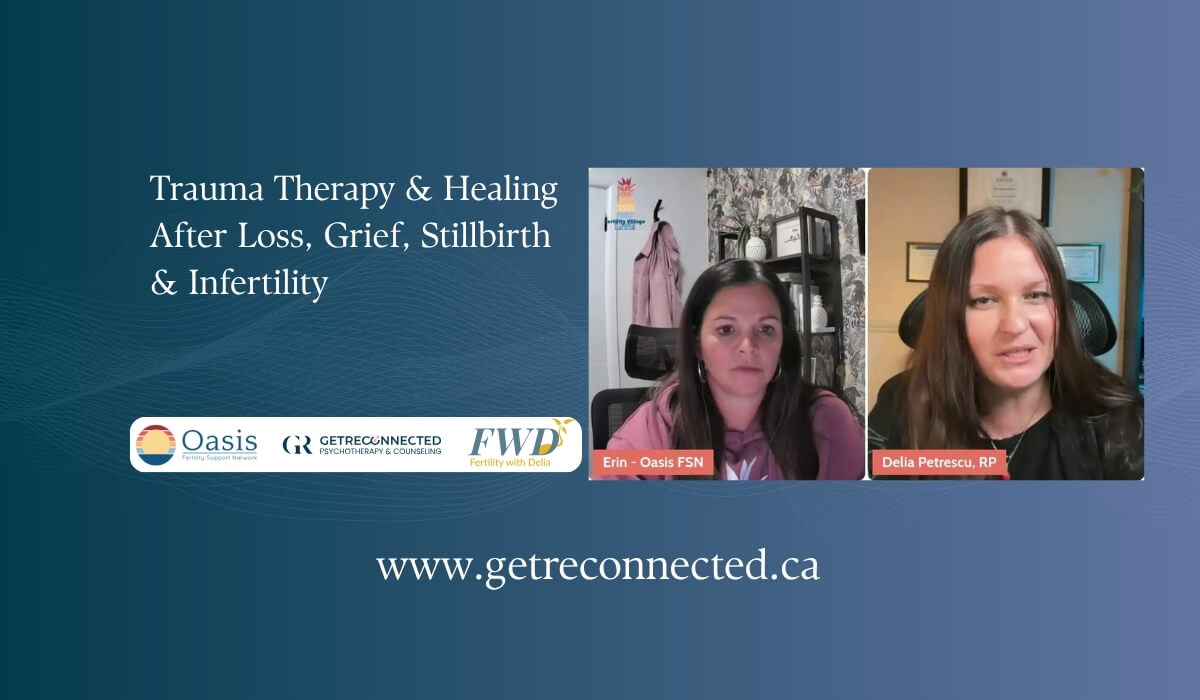
Delia was recently a guest on Fertility Village Live, a weekly show dedicated to honest conversations about infertility, loss, and healing.
In this episode, she talks about the emotional complexity of infertility, pregnancy loss, and stillbirth — and how therapy helps process grief that often goes unseen. Delia also explains how trauma lives in the body, what emotional flashbacks look like, and why grief after infertility is so layered and cyclical.
Key Takeaways
- Grief during fertility struggles is real, complex, and often unseen — Delia calls this disenfranchised grief.
- Infertility-related trauma can live in the body, leading to emotional flashbacks triggered by baby showers or pregnancy announcements.
- Grief in infertility is cyclical — marked by repeated waves of hope and disappointment that can feel exhausting over time.
- Partners often process grief differently, which can lead to misunderstandings if those differences aren't acknowledged.
- Healing involves nervous system safety and self-compassion — grounded hope rather than forced positivity.
Background & Expertise
Delia shares her credentials and personal journey: "I'm a registered psychotherapist and I specialize in fertility counseling, reproductive trauma, and also pregnancy loss." She emphasizes that "this journey isn't about the outcomes, but also surviving the in-between."
Understanding Infertility Grief
Grief from infertility often manifests as disenfranchised grief — losses society doesn't typically recognize. The grief is layered: "we're grieving the loss of the future that we imagined… the loss of the timeline… the loss of innocence."
This grief is also cyclical. Each new treatment cycle brings fresh hope, and each setback compounds the loss. Over time, this pattern can become exhausting in a way that's hard to explain to people who haven't experienced it.
Trauma & The Body
Delia explains trauma this way: "Trauma is not defined by what happened by the event itself, but it's basically the way our body responds to that event — how what it feels unsafe or what feels threatening."
Infertility often qualifies as "small t trauma" — repeated, compounding wounds rather than a single catastrophic event. Unlike a one-time crisis, fertility struggles can stretch over years, with the body never quite getting to feel safe.
Emotional Flashbacks
When triggered by baby showers or pregnancy announcements, people can experience emotional flashbacks where "our bodies remember" previous heartbreaks. These aren't random reactions — they are physiological responses rooted in the nervous system's memory of pain.
Understanding this can help people be gentler with themselves when they find themselves suddenly overwhelmed in what seemed like a harmless moment.
Partner Grief Differences
Partners grieve in vastly different ways. One may need to talk openly while another distances themselves through work or activity. Delia stresses: "Different doesn't mean less" — a partner who goes quiet isn't grieving less. They're just grieving differently.
Acknowledging these differences, rather than reading them as indifference, can be one of the most important things a couple does to protect their relationship through the fertility journey.
Therapeutic Approaches
Delia uses somatic work and Accelerated Resolution Therapy (ART), which employs "bilateral stimulation and guided eye movements to help the brain reprocess the traumatic memories." This allows clients to retain the facts of what happened while preventing those memories from hijacking the nervous system in the present.
The goal isn't to forget what happened — it's to be able to remember without being flooded by it.
Managing Stuck Feelings
Rather than viewing stuckness as failure, Delia validates it as a sign that "your nervous system [is] telling you that this loss might require more time and processing than you could have anticipated."
Being stuck isn't weakness. It's information.
Self-Compassion Strategies
One practical tool Delia recommends: writing down evidence of your own resilience — moments when you advocated for yourself, kept going when you wanted to quit, or showed up despite everything. Maintaining this list helps counter the automatic negative thoughts that infertility can fuel.
Grounded Hope vs. Desperation
Rather than swinging between blind optimism and catastrophizing, Delia advocates for grounded hope — anchoring expectations in reality. Before a new treatment cycle, acknowledge the statistics and have a contingency plan for both outcomes. This isn't pessimism; it's preparation that protects your nervous system.
Life Beyond Fertility
Finding joy and identity outside the fertility journey isn't distraction — it's survival. Delia calls it "surviving the in-between." Building resilience in other areas of life gives you something to hold onto when the fertility path is at its hardest.
Related Resources
Pregnancy Loss: Living with the Children Who Never Were
Is Infertility a Trauma? Understanding the Emotional Impact of Fertility Struggles